A laptop recycling facility is one link in a chain of several businesses, each with its own economics, and the chain decides what gets recovered long before anyone unscrews a case. Understanding the sequence explains why some materials come back as new products and others quietly disappear.
Where the process starts
A recycled laptop begins at a drop-off point: a retailer counter, a municipal depot, a corporate IT asset disposal contract. From there it moves to a consolidator, and then to a processor. The processor’s first job is triage. Roughly 15 to 25 percent of consumer devices arriving at a typical Western processing plant still work, or work with a battery or charger. Those set aside for refurbishment. The rest head for dismantling.
Triage is where the value is decided. A five-year-old business laptop with an intact screen and a healthy drive is worth $80 to $150 refurbished. The same machine with a cracked panel and a swollen battery is worth a few dollars in parts and materials. The processor’s incentive is to find the first kind, which is why consumer devices with missing chargers, and unknown data status, are the ones most likely to skip the second life and go straight to destruction.
The second life
Refurbishment is the highest-value outcome in the chain, and also the most energy-efficient one. A refurbisher tests memory and storage, wipes drives to a recognized standard, replaces worn batteries and keyboards, reinstalls an operating system, and resells the machine, typically through export markets in Eastern Europe, West Africa, and Southeast Asia. A machine refurbished for $60 in labor and parts avoids the roughly 300 kilograms of carbon dioxide equivalent embodied in manufacturing a new laptop.
Data destruction happens before any of this. Under most national rules the processor must certify that storage was wiped or physically destroyed, and business contracts specify the standard. Drives that fail a wipe, or machines with failing disks, are pulled and shredded later in the process. Certificates of destruction flow back to the original owner. This compliance layer is unglamorous and non-negotiable, and it is a real cost center for processors.
Dismantling and shredding
Machines destined for materials recovery are first stripped by hand of anything hazardous or valuable before the shredder: batteries, which are a fire risk in bulk storage, and mercury-containing backlights in older panels. Workers pull circuit boards, hard drives, and memory modules for separate processing. The remaining chassis goes into an industrial shredder that reduces it to fist-sized fragments in minutes.
Separation then does the sorting that hands and magnets cannot. Overband magnets pull steel. Eddy current separators throw aluminum out of the stream. Air classifiers and density tables separate plastics from glass and fine metal. Optical sorting picks specific polymers by color. A modern plant recovers 90 to 95 percent of the metal in the input stream by weight, and considerably less of everything else.
What comes out
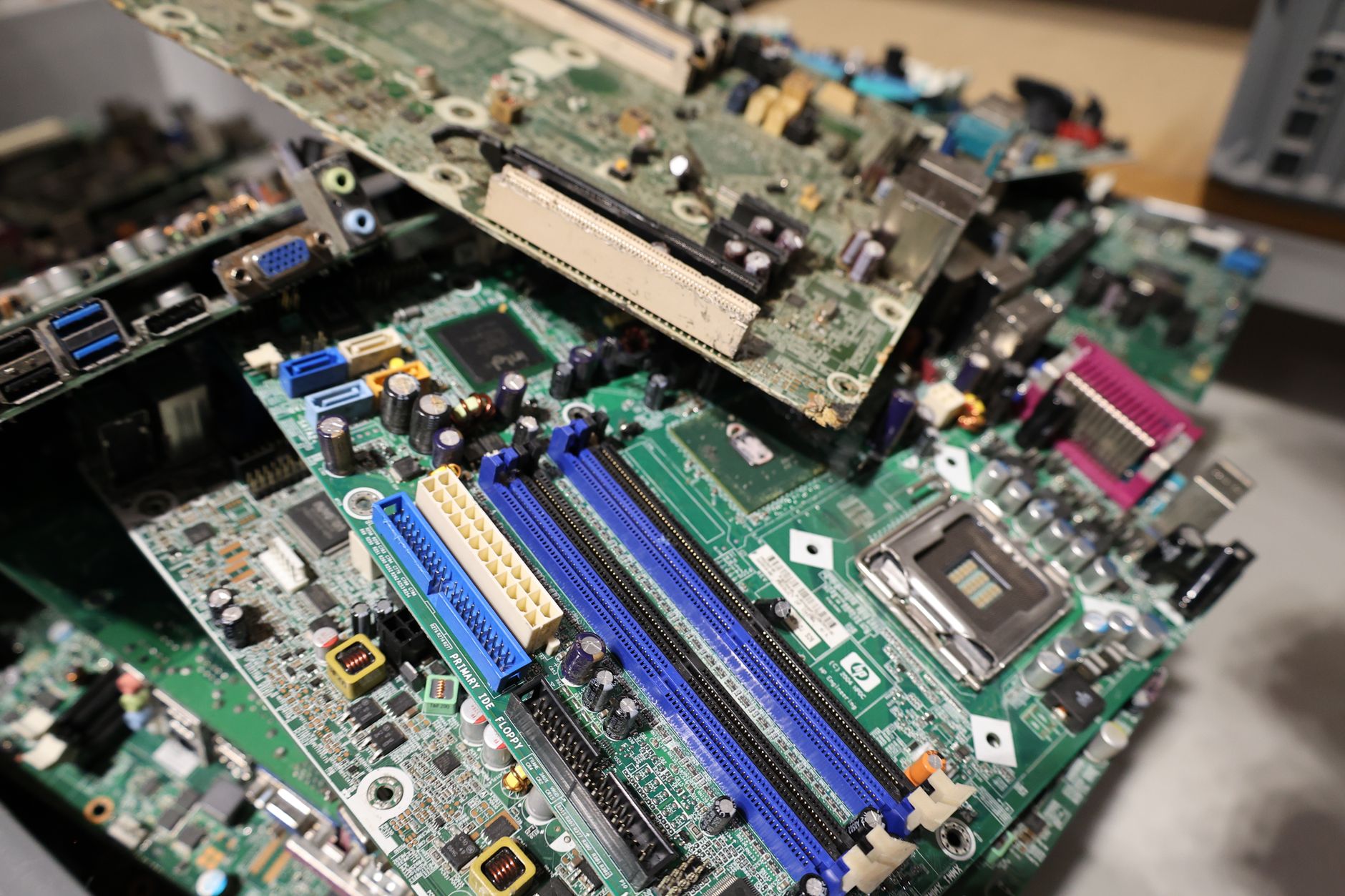
The recovered fractions have familiar destinations. Aluminum, mostly from cases and heat sinks, is remelted into new ingot at a fraction of the energy of primary smelting. Steel returns to the furnace as scrap. Copper from wiring and board traces is the most valuable metal stream per kilogram. Circuit boards go to a smelter, either in Europe or increasingly in Asia, where precious metals are recovered: a tonne of laptop boards holds roughly 250 to 350 grams of gold, several kilograms of silver and palladium, and a great deal of copper. Compare that with gold ore, which yields 5 grams or less per tonne of rock, and the economics of urban mining come into focus.
Plastics are the weak point. Laptops use blends of polycarbonate and ABS, often flame-retardant and often mixed by color, and the result after shredding is a low-grade material suitable for cable ducting and pallets rather than new laptop shells. Glass from screens is largely a disposal cost, and display panels themselves are processed by specialist firms for their indium and rare materials.
What stays lost
Several materials effectively leave the economy at this point. Rare earth magnets in speakers and hard drives are recovered by only a few specialized plants because they are small, embedded, and expensive to extract. Adhesives and composite laminates resist every separation method. The tiny amounts of tantalum, cobalt, and gallium scattered across a board end up in slag when the copper is smelted, too diluted to chase. And in total mass terms, 20 to 30 percent of a typical laptop leaves the plant as residue: mixed plastics, dust, and contaminated fines bound for landfill or incineration.
This is the part of the story that rarely appears on a recycling label. The process recovers metals well, recovers plastics poorly, and recovers almost nothing that is small, embedded, or bonded. Which is why the order of preference has not changed in twenty years: keep the machine in use as long as possible, pass it to refurbishment when you are done with it, and recycle it only when it can no longer serve anyone. The chain is good at what it does. It works best when it has less to do.